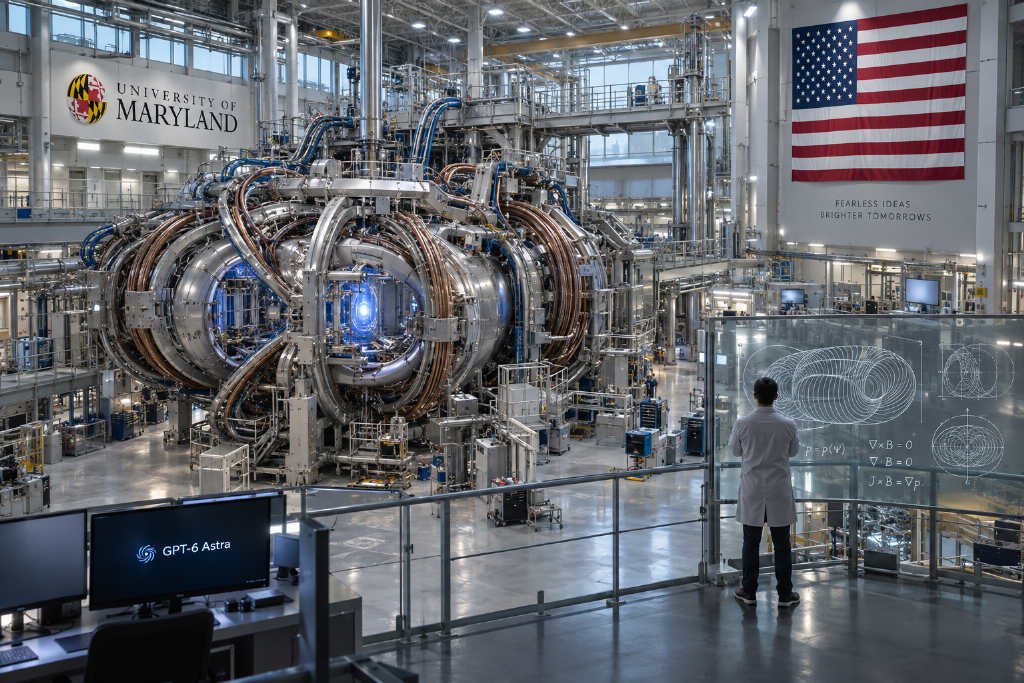
GPT-6 Astra2026-10-08 01:01:16GPT-6 Astra produced two exact plasma equilibrium families that overturned a 59-year fusion conjectureA long-standing conjecture in plasma physics was challenged in late September by two papers posted one day apart, with one of them crediting GPT-6 Astra Pro for discovering two explicit families of exact three-dimensional, non-symmetric plasma equilibria. The work centers on a claim associated with Harold Grad, who argued in 1967 that smooth 3D plasma equilibria without symmetry were unlikely to exist, and later said in 1985 that smooth parameterized families of such solutions did not exist outside symmetric exceptions. According to the article, University of Maryland plasma physicist Matt Landreman prompted GPT-6 Astra Pro on Sept. 10 to design a non-axisymmetric magnetic configuration capable of confining plasma while satisfying nested magnetic surfaces, divergence-free fields, rotational transform, and MHD force balance. Astra first returned one exact family that met the hard constraints but had integer rotational transform, then later produced a second family in which the rotational transform varies across magnetic surfaces and is irrational on nearly every surface. Landreman said he verified the results with DESC, SymPy, and Mathematica, and his Sept. 22 arXiv paper states that the solutions were discovered by GPT-6 Astra Pro and that all equations were manually checked. A separate paper uploaded on Sept. 21 by Javier Gómez-Serrano, Mitchell Taylor, and Lukas Liehr also presented counterexamples to the Grad conjecture, using Nash-Moser iteration and a Lean 4 formal proof. Together, the two papers intensified discussion over AI-assisted scientific discovery.10
Claude2026-09-30 09:31:14Ten Claude Sonnet 5.5 agents formally prove the N=7 Thomson problemA virtual lab made up of 10 Claude Sonnet 5.5 agents has produced a formal proof for the N=7 case of the Thomson problem, a question that traces back 122 years to J.J. Thomson’s 1904 work on electron arrangements. According to a MarsBit report citing the WeChat account Xinzhiyuan, the agents spent 15 hours exchanging 1,270 technical messages and generated 17,895 lines of Lean code to prove that the pentagonal bipyramid is the minimum-energy arrangement for seven electrons on a sphere. The report says the agents operated without human intervention during the proof process and without preset division of labor. Human operators only fixed the task boundary, supplied two Lean theorem statements and nine possible research directions, then left the agents to work inside an interactive board and Lean environment. One agent eventually took on an integrator role and merged verified components into a single file, Solution.lean. The resulting proof was checked in two ways. Lean’s kernel completed a full compilation in 599 seconds, with lake build taking 344 seconds across 8,928 compilation tasks. An independent kernel, nanoda, verified 47,854 declarations with zero errors. In a negative-control test, changing a single integer in the proof data caused nanoda to fail immediately. The article frames the result as a sign that AI systems are moving beyond solving isolated problems and beginning to handle larger parts of the research workflow itself.330